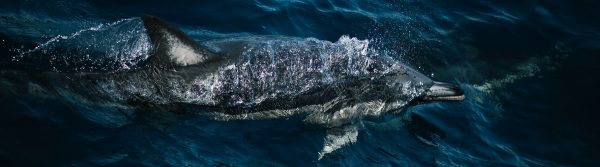
Caught up in the euphoria of first love and simultaneously wrestling with the push and pull between the secular and the spiritual, the teen narrator of Alex Miller’s “We Who Sleep in the Dust of the Earth” describes a romantic encounter: “Desire transported us from the mortal realm to somewhere magical, where we were free to live and love without boundaries or interference, somewhere like the kingdom of God.” In this issue’s stories and essays, characters and writers are contending with the nature—physical and philosophical—of boundaries, barriers, and borders. In Renée Branum’s “The Drive Out,” a woman continually compelled to escape the confines of the city revisits a violent confrontation and reflects on the precarious boundary between witnessing and intervention. A young woman working with a captive dolphin plots to release her in Caylee Weintraub’s “Keepers,” a story that grapples with the enclosures imposed upon us—and those we impose upon ourselves—as well as the fraught relationship between the human and animal world: “I’d see myself reflected in her eyes and think, That’s me, there I am.” And in Joy Castro’s “A Word of Advice,” a woman observes, at an international dinner party, various barriers—language, class, and nationality—while considering the viability of her new marriage. In her essay “Resuscitated Fallow,” Sarah Southern explores food heritages—in particular, Japanese soba-making—and the ways they move beyond geographic boundaries and are “borrowed, blurred, and blended” as “ingredients transcend borders.” David Rompf’s “Pain Points” contemplates how pain trespasses between mind and body as patients, doctors, and insurance companies occupy maddeningly separate territories. And Brittney Corrigan, in “Dead Air,” suggests a way to permeate the wall between here and the afterlife (the ultimate border crossing): the recorded voices of the departed, in which “a pathway opens up between us: the dead and the living,” one “impossible for death to scythe.”
While border conflicts of all varieties continue to bedevil our species, there is one place of refuge we can always count on: art. Between the covers of this issue, we hope you’ll find sanctuary in the fiction, nonfiction, and poetry we’ve gathered here for you. Welcome to the summer issue: Make yourself at home.
—Stephanie G’Schwind, Editor-in-Chief
I think about heat a lot. Rising temperatures. Summer’s arrival earlier and earlier. My cheeks after reading the news. Unnatural cycles making me feel, as in Reyes Ramirez’s poem—“i’m composed of crawfish boiling alive all day”—irritated at every unctuous encounter. I am snagged by Kenzie Allen’s “I am absolutely absurd.” Aren’t we all absurd in the current moment? These poems make me want to reclaim the absurd, to wield absurdity as a mechanism to listen, to reimagine, to believe in a way of moving with collective sociopolitical, environmental, and existential grief.
I’m not sure what to do with all this heat and grief other than trust permeability. In this issue, the poets’ visions collapse time, making past and future undeniably present. ire’ne lara silva writes, “when I am tending my brother’s grave, I’m also tending / my own. these wildflowers are also for me.” What we tend now, as a collective, matters. Jennifer Maritza McCauley writes, “The news seems to only know old blood and halved bodies.” And yet jazz. And yet dulce in the teeth. These poets chart ways of moving with—with becoming, with the sensuous, with the mundane, with the more-than-human, with possibility.
Maybe we all need to be casting more spells, letting our magic parts out, to better break cruel cycles. After reading Angela Tharpe’s poem, I walked around for days saying, “I curse you” to social media. “I curse you” to the news. “I curse you” to atrocious legislation. Curses until they became littler and littler, the very air melting them. In my absurd actions, I feel more connected. In the absurd, the quotidian sparks movement.
Fatimah Asghar writes:
around us,
nests of caterpillars cocooned
chrysalises of their own becoming.
like them, we were becoming.
you & i, becoming.
Here, homecomings are possible, prayers to softness exist, and “if the angels are not concerned / with being pretty, then why / am i?” I find myself praying to the caterpillars before they cocoon, to softness, to round out my sharp parts. The angels are absurd, but so am I. Here I think of Donika Kelly: “And so: surrender.” I surrender to the absurd as teacher, to softness as mentor. This connection keeps me moving with the heat. These poets know how to move, how to take us with them.
—Felicia Zamora, Poetry Editor
Featured in this issue:
Kenzie Allen, Fatimah Asghar, Renée Branum, Joy Castro, Brittney Corrigan, Laura Grothaus, Yalie Saweda Kamara, Donika Kelly, Trevor Ketner, AJ Leigh, Malia Maxwell, Jennifer Maritza McCauley, Alex Miller, Rebecca Morton, Supritha Rajan, Lana Reeves, David Rompf, Ire’ne Lara Silva, Sarah Southern, Angela Tharpe, Laura Villareal, and Caylee Weintraub