Editorial assistant Mai Gokkaya discusses “The House on Front Street,” featured in the Spring 2024 issue of Colorado Review, with author Alix Ohlin.
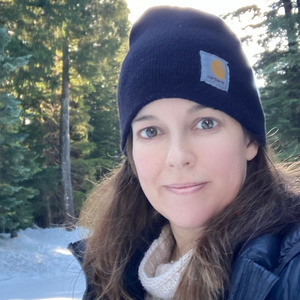 Alix Ohlin is the author of three novels and three story collections, including the most recent, We Want What We Want (Vintage/Anansi). Her stories have appeared in The New Yorker, Best American Short Stories, and many other places. She lives in Vancouver and teaches at the UBC School of Creative Writing.
MG: Before anything else, I would like to talk to you a little bit about “The House on Front Street.” The story is focused on relationships that are not generally highlighted; neighborly relations of all sorts, a fleeting one-night-stand-turned-acquaintedness with the local bartender, a connection made with a cat during a borrowed time… Why do you think such relationships are often overlooked in literature while significance is put into relationships with classic, romantic nature?
AO: That’s such an interesting question. There’s a philosopher named Kimberley Brownlee at UBC, where I also teach, whose work focuses on our need for social connections of all kinds. In her book Being Sure of Each Other she shows how fundamental interpersonal relationships are to our sense of purpose and agency, our core identities. Without other people, we don’t know who we are. I think research like hers, as well as psychological and medical evidence, is showing how crucial these sorts of interactions are to our individual and communal health.
The effects of the pandemic, which wrested many people away from their usual interpersonal networks, are still being felt. “The House on Front Street” is set during a time of instability—in the midst of the pandemic and in the midst of climate change, when our expectations and understanding of weather patterns have been ruptured, and everything feels off-kilter. Given how important these factors are to people’s lives, to their understanding of themselves and their values, it makes sense for literature to attend to them.
MG: I’m always drawn to complex women characters with labyrinthine inner worlds which is why Kim, the main character, has captured my attention so deeply. How do you build such elaborate characters within the bounds of short stories?
AO: My not-at-all original theory of writing, and of life, is that most people are, on some level, weirdos. Meaning that once you scratch the surface of even the most seemingly regular existence, you’ll find some weirdness, the messiness and vulnerability and strange decision-making that are part of being a human. For Kim, if you passed her on the street, I don’t know that you’d give her a second glance. But her life has tipped out of balance and she can’t get it back, and the thing that tipped it was putting her love and energy in the wrong place. It could happen to anyone.
On a craft level I think a lot about juxtaposition and how small details can stand for a more significant whole. Things like a sudden blizzard and a sparking power wire. Kim giving her boss a cigar and watching his reaction to it, or seeing herself captured in a drawing made by her neighbour. My hope is that the reader can absorb these details and locate the characters through them, which is similar to how people become legible to us in life.
MG: Speaking of short stories, how would you describe your relationship with writing short stories? What about them speaks to you as a writer?
AO: Short stories are my favorite form and where I feel most myself as a writer. I think they reward flexibility in structure, and risk-taking. A great short story is like a song: you can read it fairly quickly and then it lingers in your mind afterwards. I just read a story by Sam Lipsyte in The New Yorker this week, “Final Boy,” that I loved. It’s a grim and hilarious story about AI and death and fan fiction and how we hang on to things—ideas, relationships, maybe life itself—long after they are habitable. All these elements are crammed into the story like an overstuffed suitcase and you get these startling, dense layers of tone and theme. In a novel the narrative ingredients could easily slacken but the compression of a story maintains the tension beautifully. To me it’s a perfect reading experience and that’s what I’m drawn to emulate in my own writing.
MG: In a previous interview, you mentioned you enjoy building connections and draw attention to under-written relationships, but you also talked about playing with form as something that you like as well. With all that being said, going forward, what will be your priority in your future projects?
AO: I like to work on multiple projects at the same time—a novel and a story collection, usually, and I’m doing that now. Right now I’m writing about life in the Anthropocene, and how we understand the fractures and vulnerabilities associated with that. Notions of loss and disappearance tend to dominate my work, and I’m interested in various approaches to that. I teach a class at UBC on climate writing, and I’m thinking a lot about climate and the imagination—what forms can we use to narrate the world as it is right now? I think a lot about Amitav Ghosh’s The Great Derangement and his arguments about how the Western literary novel has failed to grapple with climate change and its scale. I do think there’s a lot of exciting and stirring and heartrending work being written these days around climate, books like Yun Ko-eun’s The Disaster Tourist, or Diane Cook’s The New Wilderness to name a couple, and I’m reflecting on what form my own work will take.
MG: To carry on with the theme of reading, I’ve always seen reading as a source that fills our cups for writing. What are you reading right now, or what is in your ‘to be read’ pile, that excites you?
AO: I’ve mentioned a few things already, but I’ll add The Calculation of Volume series by Solvej Balle, which I’ve really loved so far. These books are about a woman who is trapped in a single day, November 18. The premise is so simple and yet the books are always investigating new dimension of the idea, the rupture in her relationship with her husband, her family of origin, her connections to the seasons, to home. I’ve been rereading the short stories of Mavis Gallant, forever one of my favorites for her astringent gaze. Pick a Color by Souvankham Thammavongsa, about women who work in a nail salon, is a delightful novel I read recently. I love her voice.
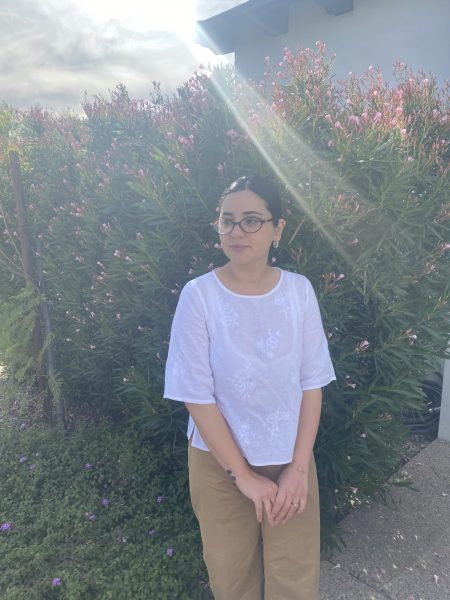 Mai Gokkaya is a graduate student at Colorado State University, pursuing a master’s degree in literature. She is also an editorial assistant at the Center for Literary Publishing. Her research is focused on queer literature and she hopes to contribute to queer WOC representation in literature.