Asha Futterman discusses “Song of Gray,” the winner of the 2025 Colorado Prize for Poetry (available for purchase here), with associate editor Autumn Koors-Foltz.
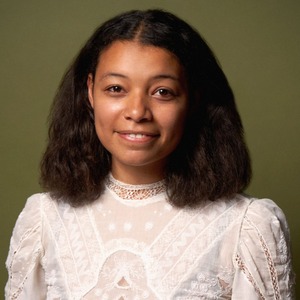 Asha Futterman is an actor and poet from Chicago. She holds an MFA in poetry from Washington University in St. Louis. Her chapbook, empathy, was published by The Song Cave in 2024. Her poems have appeared in Poetry, Bennington Review, Conduit, and The Journal. She currently teaches children in Brooklyn.
Autumn Koors-Foltz: There was so much in Song of Gray that moved me and caught my attention, but maybe the central place to start is the book’s approach to performance. I was wondering if you’d be able to talk about how you’re navigating and approaching this idea through the collection.
Asha Futterman: I’m an actor, and I think about acting and performance a lot. Poetry has helped me to think about how, when I’m acting, the performance is agreed to. I’m performing, there’s an audience, and everyone knows it’s a show. With writing, it feels different. Performance is happening, but the stage is less clear in a way that’s more similar to day-to-day life, where we’ve not entered the agreement of performance officially, but maybe we have unofficially. I was interested in thinking about what both states of performance allow.
I was performing for some of the time I was writing the book, and different kinds of performance were blending into each other. The performativity of the company I was performing with was blending into the show, and then that was all blending into life—so, really testing ideas of when and where and why we are performing, even on stage, was exciting to me at the time. The stage lays everything bare in a way that makes poems interesting.
AKF: That’s fascinating. I’m so interested in this idea of boundaries in performance. It makes me curious about the ideas of performers, audiences, and readers, and when that blending happens in everyday life, how that discernment happens. Too, I’m curious if you could talk about maybe some of the connections or disconnections you see in your art as a writer and as an actor and how they either speak to each other or don’t speak to each other.
AF: Over the last summer I did a contemporary performance practices workshop, and it really helped me ground myself in knowing that the place where acting starts is the center of my body. Acting feels very physical in a way that poetry doesn’t and language doesn’t. It’s an art of the physical form, and poetry is not physical, in a way that can be frustrating and freeing. So, that’s how I view them as separate, but I’m interested in the space between language and flesh. And I’m interested in the difference—I learned from the actor Ellen Lauren that priests used to sit in the middle of the big amphitheaters in ancient Greece, and when you know you’ve communicated something real during a performance, you’ve sent your voice not only to the audience or your scene partner but also to the priest and through him to God. And God sends your voice back down to everyone, and that whole process of physicalizing your voice happens starting with your feet on the ground and feeling the world beneath you. I wonder how that happens in the form of the poem; when something important is communicated, it should probably come from a similar place.
AKF: Acting feels like it’s communal in a different way—a lot of people present in the room—but oftentimes, there’s a temporal separation in writing where, at the very least, there’s a delay between it happening and being received. That feels so different.
AF: Yeah, the delay. That’s really smart. Acting is so much about the moment, the immediate communicating. It’s about the actor on stage and the audience, it’s about that moment, and it’s about the moment of the play and the scene. There’s that delay. During poetry readings, a lot of times readings get muddled because that communication doesn’t hit in that same immediate way that it really should with theater.
AKF: The awkwardness of poetry readings—I always feel like people are asking, “Are we doing the snapping thing?” or, “Are we all going to be quiet?” It feels like maybe there are fewer accepted rules for receiving a performance like that.
AF: It’s more complicated to be an audience member during a reading. The performance agreements are different. Maybe that has something to do with the way we’re trying to experience a moment. Maybe it’s because as poets we already feel we’ve done our job communicating through the language, and so we are less interested in trying to communicate it through our voice and body.
AKF: For my next question, I was wondering how you’re thinking through location and mapping. There’s so much movement through different spaces throughout the collection. How do you approach location and mapping, though?
AF: The particulars of my world and the world I’m writing are necessarily going to be the particulars of the worlds of my poems because I’m really trying to communicate as exactly as possible.
I read in an essay Craig Morgan Teicher wrote about “Girls Overheard While Assembling a Puzzle” by Mary Szybist that the point of poetry is like trying to communicate to each other what we see as blue (or any color). I want you to see my blue as exactly as possible. I think I try to get to that particularity through location and those sorts of details being present and accurate. It doesn’t feel too frivolous to me; it textures my blue.
AKF: The evocative way specificity works holds all the resonances even if there isn’t necessarily an immediacy to what that detail means. The meaning saturates the piece and you feel it. I’m curious about how that’s working with naming in your poems.
AF: Just like the names of locations, the names of people being accurate and true to life gives the world a more accurate texture. The texture of my world is these specific names and putting that accurately into poems brings a similar texture inevitably. It’s hard for me to change a name in a poem unless it’s necessary.
AKF: There are so many different approaches to naming in poetry. The real name, the pseudonym, and the initialism feel like they embody what somebody’s poetics are. I’m curious if you have any thoughts on your work’s relationship with accuracy and truth?
AF: My goal is to communicate something and say what I really mean. I feel like I get there through trying to take away everything except for exactly what I mean or details that get closer to meaning.
AKF: Did it feel like that relationship changed any in the course of approaching a collection, thinking through one poem versus within a collection where there’s a relationship between the poems?
AF: When I read my poems altogether, or my friends I was with when I was writing them read them, one of my friends was like, “Your poems are so much about St. Louis!” A nice picture of St. Louis, Missouri (laughs), and I thought that was really nice. One poem at a time, I didn’t see a city coming together. But as a collection, it was nice to see how they can function as a bit of a map of St. Louis and some other places in my life.
AKF: What a gift to have these things come up naturally, organically. These are things that exist but take a minute to examine and pull out. A question I would really like to ask is, what is it that you find fuels your work and creative practice?
AF: Restlessness, confusion, and a desire to see myself and for that to become something physical or concrete like a poem, and wanting to communicate honestly with people. I want to see myself and my world in some sort of concreteness. I feel really happy that language has been able to be that form for me and a way to see myself and communicate.
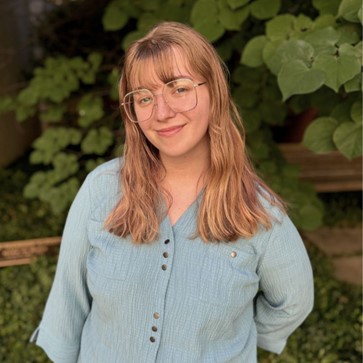 Autumn Koors-Foltz is a second-year MFA student in poetry at Colorado State University, where they serve as an associate editor for Colorado Review. Their poetry can be found in places like Red Ogre Review, Ghost City Review, and the sound a wishbone makes when it snaps.