Associate editor Alaina Villoria discusses “The Little Spragger,” featured in the Fall/Winter 2025 issue of Colorado Review, with author Amanda DeMatto.
 Amanda DeMatto’s fiction has appeared in The Cincinnati Review and is forthcoming in Boulevard. She received an MFA in creative writing from Brooklyn College. She divides her time between New York City and New England and is currently at work on her debut novel.
Alaina Villoria: Your prose in “The Little Spragger” is incredibly atmospheric, with an immediate emphasis on the earthly landscape and the natural world. To quote, “Everything was impressionistic—a mere suggestion of its true form,” feels like a line that summarizes the readerly experience of this story quite well. Are you usually drawn to more atmospheric styles of writing? And, I’m curious as a place-based writer myself, how do you balance the presence of the atmosphere in the story without sacrificing the structure or “meat?”
Amanda DeMatto: I love a good, palpable atmosphere—that a few words on a page can make you feel like you’ve got dirt under your fingernails or sleet on your face—but I’m not sure it’s characteristic of all my writing. I knew very little about this story when I sat down to begin, only that there would be an old man and a little boy, that their relationship was precious, and they would have an adventure together involving a lustrous ball. I didn’t know there would be a tragedy. I think, ideally, every story commands or should command its manifestation. If we really let go and inhabit the world that we’re writing and listen very closely, the story whispers to us what it needs to be. It cracks open and reveals itself—its scaffolding, its particular lexicon, mood, atmosphere. When that happens, for me, the ideas come swirling at breakneck pace, tempestuous, amorphous, and you almost can’t write fast enough to give them shape. That’s how it was with this story. I feel lucky for that.
The atmospheric elements came from the landscape and state of the weather at the time I was writing. It rained for days. A veil fell over the senses. It seemed no matter where I looked, every square meter of grass contained a robin. Where there are robins, there are grubs. I love watching animals and insects going about their business. As I was spying, it struck me that there was something very spooky about the abundance and the arrangement of the birds. It felt important to capture that eerie mood. Though visibility was poor, I tried to describe as vividly as possible the conditions around me. But try as one might, vividly describing hazy, wishy-washy figures does nothing in the way of offering clarity of vision or thought. That, too, worked in my favor, in that it mirrored the fluidity and fallibility of memory, the mutability of perception, especially for those who are mourning. I think the old man’s dementia and grief were actually born out of that ominous cloud cover and heavy precipitation. These characters are trapped in a literal fog of grief. The pathetic fallacy, where the natural world reflects a character’s mood and vice versa, was working well here.
But the weather doesn’t function solely as a means for descriptive setting. It’s also a catalyst for the disaster. It’s the erosive engine that drives the action of the story forward, even if you’re not seeing all of the action play out on the page. I guess that could be why the substance of the story is not a casualty of the dense atmospherics.
AV: “The Little Spragger” ends on a slightly ambiguous note. Is this something that you do in other stories of yours, and/or, how do you decide what the “right” ending for a story is? What is your goal when you complete a short story? When you begin a short story, do you ever have the ending in mind, or is that something that you discover throughout the drafting/writing process?
AD: It’s a kind of sabotage, for me, to lord an ending over a story before I’ve begun writing it. I might have a sense of how I’d like to see the characters have changed by the end, or what mood I hope to leave the reader with, or very broad strokes of a plot’s trajectory. But no more than that.
I do have a weakness for ambiguity. Maybe it comes from the desire to appeal to as many readers as possible and maybe it’s a failure of vision. I’m probably going to lose those readers who prefer closure and are frustrated by yet another open-ended ending. I’ve always been suspicious of certainty, especially the kind that’s delivered with confidence. Our faculties of perception are extremely limited and ever influenced by our upbringings, exposures, biases. Even our most precise observations are flawed, but beautifully so. Every point has a counterpoint. At the risk of psychoanalyzing myself, I’m a fatally indecisive person. The house could be on fire, and I’ll be waffling over whether I should grab my HOKAS or my Birks (and maybe a pair of heels, just in case). I suppose this tendency towards ambiguous endings may be a product of that overarching indecision.
This is the kind of story that I believe is well-served by an ambiguous ending, though. So many of its elements are mercurial and unsound—the fragile earth beneath the characters’ feet, the protagonist’s memory, the volatile weather. Then again, maybe the better ending would have been the decisive one, to contrast all the unreliability and shaky ground that preceded it. See what I mean about crippling indecision? Now I’m doubting my ending!
To me, the “right” ending, for this story, felt like the one that occurred just before the moment of epiphany. Stories are tightly packaged slices of life, mysterious and enduring. The story continues on after the last word. Ambiguity guarantees that.
AV: You do such a lovely job writing the many layers of the unsaid in this story, especially when it comes to the grandfather and his failing memory. I feel like, typically, elderly folks and children are usually perceived as unreliable narrators, at least in some capacity, and this story closely follows both. Forgive me if this is a slightly confusing question, but how did you navigate the balance between what is known, what is unknown, and what occupies that space in between the known and unknown?
AD: Thanks for saying so! That’s a great, hard question. The answer is witchcraft! There’s definitely a subconscious alchemy at play here. The old man’s unreliability had to be established very early on. Likewise, it was critical to give concrete evidence of his son’s reliability. Once these two radically different realities were defined, it was all about reinforcing them and setting them in opposition to one another at every opportunity. You get quite a delusional concoction when you add to an already fragmentary mind the shock of experiencing a tragic event, trauma leading to additional memory loss, plus repression, anger, and the denial and bargaining that comes with grief. It was important to create situations for the son to establish some semblance of truth to ground the reader.
Still, I wanted the reader to trust the old man, to seek out and cling to any shred of a possibility that his version of events might have been close to the way things really were. Memory ailments are ubiquitous now. I feel like every day I happen upon an article that promises some new hack to dementia—or Alzheimer’s—proof one’s future. And we see how excruciating it is for so many folks whose loved ones have lost that war. I think we’d all want to give the person with dementia the gift of belief. I certainly wanted to believe the old man as I was writing this. Even his son tries to protect him by cooking up stories about Jack’s disappearance and glossing over the real events of the tragedy. Treading the line between the known and the unknown was very difficult at the beginning of the story for this reason. In retrospect, I think it helped to maintain some narrative distance from the son, since he has the advantage of credibility.
What occupies the space between the known and the unknown is the chaos of understanding, I suppose, a grappling. It’s the teeming, fertile place where ideas go to be distorted or clarified. One of these liminal spaces is the scene that follows the old man into his home after the disaster. This scene is delivered to the reader as a memory. Because it’s a retelling through the old man’s consciousness, its veracity is automatically suspect, but we’re not quite sure which parts exactly. He’s replayed the scene over and over again in his head. Ultimately, he invents (and believes) a more acceptable outcome—Jack is with him in the house, safe and sound. But I tried to sprinkle in some evidence to the contrary, casting doubt on Jack’s presence—the old man has his own misgivings (“the old man rested his hand on the boy’s head, didn’t he?”); the pasta sauce bubbles over the pot on the unattended stove (grandma may have been cooking and abandoned her station when the old man returned from the field without Jack); “the red swell and blue fade of sirens whooshing by” (which could be the sirens of a real fire truck/ambulance rushing to the field outside, or a symbolic reflection of the alarm the old man was feeling at the time). Where ambiguity prevails, the reader has an express invitation to play a more active role as architect of the story’s reality.
AV: I would love to know what your writing process is like. Do you have any rituals, or do you find that it is more intuitive?
AD: It’s more intuitive for me. I wish I could say I go to the chair daily, light a candle, say a prayer to the Muses, and stop up my ears with silicon until I reach quota. But I’m not one to force things. That’s not to say that I’m not constantly thinking about writing or trying to get my brain to stop thinking about writing so that I can be present in the moment with others. I’ll collect material and mine potential avenues and brood over nebulous snippets of a nascent story in the precious minutes that can be scraped together. And then I go where I feel invited. If a story doesn’t let me in, it’s going in the folder. The one constant is that when I’m working on something and feel the story has somewhat revealed itself to me, then I will buckle down and spend every night after work and every weekend in this tunnel of productivity.
AV: As writers, I know that we are often informed by what we read. I’d love to know what you’re reading right now that is inspiring you and your writing, or if there is anything else that is creatively informing you right now. Personally, if I’m ever feeling bogged down with reading, I will often turn to music and artwork for inspiration instead.
AD: I love that you turn to music and art for inspo! I’ve played the piano for a long, long time and music is where it’s at for me. Chopin, Rachmaninoff, Mahler, Sibelius—I listen to them obsessively. Christopher Tin’s The Lost Birds. Max Richter’s Sleep. Bowie, Wilco, Radiohead, Billie Eilish, Frank Ocean, Blood Orange, Fiona Apple, Led Zeppelin, Cat Power, Future Islands, Labrinth. The diet is omnivorous. I was fortunate to see Tristan und Isolde at The Met this March. That one brings on the waterworks. I walked away full of wonder and gratitude for Wagner for creating this masterpiece that humans still cherish almost two centuries later, despite the controversial figure he cuts. As for literature, anything by Virginia Woolf, Mary Oliver, Italo Calvino makes life worthwhile. Books that I’ve read recently and enjoyed include Transcription (Ben Lerner), The Old Man by the Sea (Domenico Starnone), The Empusium (Olga Tokarczuk), Underland (Robert Macfarlane), Foster (Claire Keegan), Fever Dream (Samanta Schweblin), A Swim in a Pond in the Rain (George Saunders)… I could go on!
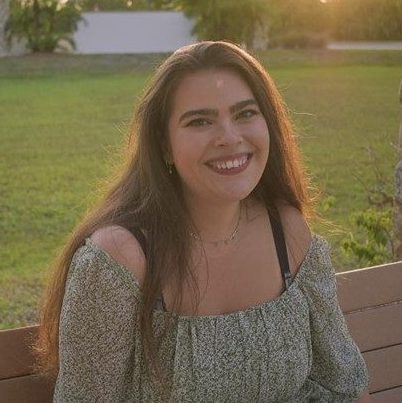 Alaina Villoria is a third-year MFA student in fiction, where she is an associate editor at the Colorado Review. Her writing is place-based and often set in Florida, where the setting is a central character in her short stories.