Angela Tharpe talks surreal encounters, creating space with punctuation and pronouns, her poems in the Summer 2026 issue of Colorado Review, and culture recommendations galore with associate editor Kyle Mayl.
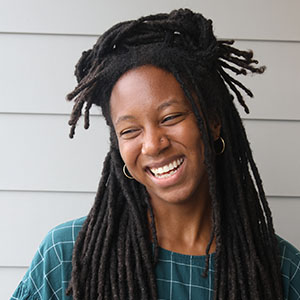
Angela Tharpe is a writer and teacher living in Atlanta, Georgia. She received her BA in English from Baylor University, her MFA in creative writing from the Iowa Writers’ Workshop, and her PhD in English at Emory University. You can find her culture blog and other work at angelatharpe.com.
Kyle Mayl: Thanks for coming, Angela! I’ll start with what first jumped out at me. I noticed that ampersands begin (and generally figure prominently in) your poems featured in Colorado Review. I love an ampersand. Why the ampersands?
Angela Tharpe: I love that you asked that. I started writing a series of poems about surreal, weird, fun, or surprising encounters I’ve had living in Atlanta and when traveling. I see these encounters as connected to each other. I think the same underlying things motivate or cause them—from my mom’s experience in a parking lot to being on the Beltline and someone calling my boyfriend a slur. These things happen, and they’re connected by violence. Other moments are connected by whimsy and surprise, like when that guy [in “BOGO”] asked me if I like smoothies. These encounters are all strange in similar ways to me. Beginning with an ampersand makes each poem part of a bigger project and shows how these encounters are related to one another.
KM: As a reader, I feel that. It’s like the speaker is telling me a story. It’s as if we’re in a conversation page after page. The ampersand is a small thing, but it has a huge impact. On a related note, how do you approach punctuation in these poems and in your work as a whole?
AT: I come from a prose background. My MFA is in fiction. I’ve always been interested in experimental writing—in poetry, essays, short stories, and novels. Even though I’m a composition teacher and teach grammar, I use punctuation more intuitively when I’m creating. When I’m writing, it’s less “this is required” and more “this is where I feel this should go.” I’ll swap out the word and with an ampersand. I’ll add an em dash (which I love, as many writers do). I’ll add a period if I feel like there should be one, and sometimes, even though it’s the end of a thought, I don’t use a period. That type of freedom is partly why I feel drawn to poetry lately. In my prose, which is pretty voice heavy, I still do what I want with punctuation. That being said, when you’re writing prose, conventions apply more strongly for the sake of clarity. Poetry offers other ways to punctuate that provide more freedom—via pauses, a change in rhythm, or a stanza break, for example.
KM: How you punctuate your poems in Colorado Review certainly draws me down the page, one line after another. And every one of these poems makes me swing between laughter, suspense, despair, hope, joy, and beyond. The lines in “How Do I” about the Apple ad that says, “If your hands are full, / pay with your wrist!” really got me. Hilariously dystopian. How and why do you generate such disparate emotions in your work?
AT: Writing about things that are scary or violent or surprising or traumatic is healing. Writing something that’s all one tone or one feeling is sometimes necessary, but I find it so impressive when someone can juxtapose sadness with, say, humor. My husband is a stand-up comedian, so I’m around a lot of comics. Taking something painful and integrating (not flattening) it with humor can take the teeth out of violence. At least for a moment, you can make it yours. I find that so healing, especially in poetry. You can take your experience and make it into something, at least on the page. That gives me a new perspective on things, even if it doesn’t change the reality of what’s happening.
KM: What projects or artists create this juxtaposition well? Whose work do you admire?
AT: For starters, Sasha Debevec-McKenney. She was a fellow at Emory University when I was there. I really admire her work. In general, I love poets and prose writers who think about the internet and our current moment. When I was younger, I wanted to write something timeless, but the more absurd our time becomes, the more I admire writers who approach our moment specifically because it’s so surreal.
Morgan Parker was one of the first contemporary poets—and more specifically, contemporary Black poets—whose work I encountered. I was at the public library in Iowa City. I went to the poetry section, and I just found her book. I didn’t know anything about her. And then I read all three of her poetry collections: Magical Negro, There Are More Beautiful Things Than Beyoncé, and Other People’s Comfort Keeps Me up at Night. Those books really changed my relationship with poetry. As in, oh, you can talk in poetry. You can have a conversation. You can be funny. I think Morgan Parker and Sasha Debevec-McKenney both do that well.
Hera Lindsay Bird is another poet whose work I admire. Her work is funny and she’s bi[sexual], so I relate to a lot of her poems.
Also, thinking of comedians, Josh Johnson. He speaks a lot to the current moment, and he’s funny and surreal with it.
KM: I have some serious research to do! Now I’m wondering this: the ways race, gender, and other aspects of identity affect the most mundane parts of daily life seem to be central to your poems in Colorado Review. Do you see it that way? How did these poems arise, and did you have any goals in mind for them?
AT: Identity has always been important to me, both individually and from a social justice angle. I’m interested in making sure everybody is okay, is looked after, is not being bullied, or worse. I think I always come at everything from an identity angle first, especially as a Black person, as a woman, as a bi person, as a queer person. All those identities affect the way I see things. I’m also obsessed with the dynamics of people’s interactions—dating dynamics, friend dynamics, family dynamics. I’m interested in how people relate. I’m interested in how I see the world and how people see me during these intense times. If these poems that I’ve been writing lately are based on recent encounters, then these encounters are motivated by my identities and how other people (whose identities align with mine or not) see me in a moment of exchange.
In terms of the goals that I have for these poems, one goal is just processing in a way that, like we talked about, juxtaposes the seriousness of these encounters with humor. What can humor do? How can humor transform these encounters in my memory and in my processing, even if it didn’t transform the encounters in the real world? When I write about things that are painful or about kinship moments with someone like me, it’s healing. It’s almost like therapy or journaling. My brain sees it one way. Then I write the poem. The painful moment still happened, but I also remember it as the poem. The poem starts to cancel out some of the damage done to my psyche.
I also want others who share any part of my identity to feel seen. When I read poems by Morgan Parker, Sasha Debevec-McKenney, or Hera Lindsay Bird, there are moments where I’m like, “Oh my gosh, that’s me.” They’re showing me that I can write about who I am and that it’s not as simple as it seems. Everybody experiences their identity in a different way, and I find that interesting. I want other people to read my work and be like, “I see you” and “you see me.”
KM: I’m thinking about “Sellout,” your translation of a Léon-Gontran Damas poem, featured in Nashville Review. How does translation figure into your creative practice? What impact have Damas and other members of the Négritude movement had on your writing?
AT: I’m glad you found that. I love his work. He’s another great example of a Black surrealist poet. The collection that his poem is from was written in 1937, but it feels so contemporary. The Négritude movement was almost like a combination of the Harlem Renaissance and the Black Power movement. Black writers from the Caribbean and from Africa were together in Paris saying, “It’s good to be Black. We’re proud to be Black.” It was essentially an anti-assimilation movement. Aimé Césaire was one of the leaders of the Négritude movement, too. His work is so powerful. Like Damas, Césaire asked questions like: What does it mean to have gone from Martinique to Paris, then come back home? How has my perspective changed after the work of assimilation in Paris?
The collection my translation is from, Pigments, is essentially a chapbook. All the poems are conversations around feeling the need to assimilate and choosing not to. I’ve translated the whole chapbook and now I’m working on his longer book Névralgies. How does translation impact my own writing? It’s helpful to see how writers in other places are writing. It’s helpful to not be limited to texts written in English or even translated to English. I want to read in French or Spanish and know what someone said directly. But I also want to be a bridge, especially for Black writers, from an audience that speaks one language to an audience that speaks another.
I almost went to graduate school in Wales, so I stopped in Paris for one day. My mom was like, “You don’t know French. Don’t go.” And I was like, “I’m going. I’ll figure it out.” I’m really glad I went. The coolest part was how similar I felt to the Black people there. They spoke French; they were from a different culture, and yet, I felt connected to them. A lot of people there spoke to me in French. I had no idea what they were saying. There was this woman on the train telling me in French, “Fix your jacket,” when it was misbuttoned. I didn’t know what she was saying or how to respond. And then she just reached over and fixed it for me. There’s such a connection, I think, between Black people across the diaspora that can be really special.
The languages of colonization can prevent us from connecting, so doing the work of translation as a Black person for a Black writer is powerful. My PhD was in Black American literature, but connecting with the Négritude movement reminds me that there’s so much more. Similar conversations are happening across time, language, and place. The more we’re in conversation with each other, the more we’ll feel seen and express ourselves in different ways. Translation has been helpful as both a tool for understanding the Black experience and for learning from poets like Damas. When you’re translating and you figure out what a writer is saying, it feels like they’re speaking to you.
KM: Speaking of the word you, different people and pronouns (especially the second person) appear frequently in your poems in Colorado Review. How do you think of the readers and subjects of your poems? What relationship(s) do you envision with your poems’ readers and subjects?
AT: I love the second person. I love it in prose and in poems. Jamaica Kincaid’s “Girl” is a great example; she’s telling someone what to do, and it’s as if she’s talking to you. Junot Díaz’s “Flaca” is another example of a short story written to a specific you. Carmen Maria Machado experiments with pronouns, too, in both fiction and nonfiction. Maybe it’s similar to punctuation; experimentation with pronouns opens space. You don’t feel as constrained. When I’m writing about surreal encounters, sometimes it’s nice to slip out of the subjectivity of “this happened to me.” Instead, it becomes “this happened. Maybe I’m speaking to you. Or maybe it happened to you.” Maybe the second person is like the ampersand. It’s slippery. This event could have happened to you or to me, or I could just be talking to you. That movement highlights how interspersed and interconnected all these encounters are. The poem is like an attempted fever dream. Slipping in and out of pronouns is helpful for moving through that space.
Let’s see. Readers and subjects, sometimes they’re the same. I’m talking to you, the reader. Sometimes I’m talking to a specific you that did something, and I’m responding. Sometimes the you is me, but I slip out of the I and now it’s you. Or it could be you. You can resist this and say, “That’s not me,” or you could say, “Sure, what happened to me?” I try to make the you slippery. You as I, you as a specific you, you as a reader, or a different you. Maybe I’m talking to the person beside you and you’re just overhearing. I see the reader as a confidant, as someone who I’m telling this story to or as someone who could witness this thing that happened. I see poem subjects as similar. When I write, “I curse you very much,” the you is the person who did this thing, but you are also witnessing what they did. I see both readers and subjects as witnesses. Sometimes they’re directly involved, and sometimes they’re just overhearing or watching after the fact. It creates more of a sense of conversation. That’s important to me as a writer; who am I talking to? Maybe it’s just me. Maybe I’m talking to myself. Hopefully, it’s someone else who feels at least interested, if not directly involved or engaged.
KM: I feel that slipperiness. It bridges, forms boundaries, and draws attention to those boundaries. People from all backgrounds can read into that you and have completely different experiences.
AT: Yeah! I would say, too, that Citizen by Claudia Rankine is a great example of “this happened to you.” Because it’s arranged in these small bits, you don’t resist as much as you would, maybe, if it were a short story or a novel written in second person. The bits are so specific and so racial in a way that a lot of people relate to. Rankine’s use of you as I and as you is interesting and helpful.
KM: You recently completed your PhD in English Literature with a focus on Black American literature and culture. You have poems and essays published. You also run a fabulous culture blog and photo journal. How do you bridge the academic, the aesthetic, and the whimsical? In other words, how do your professional, creative, and personal lives relate?
AT: Well, accessibility is really important to me. When I first started my MFA, I didn’t know who I was talking to. I thought I was just writing—writing for me. As I got older, I realized that, as a writer, you want someone to hear you, and who you want to hear you shapes the tone of your work. During my MFA program, I felt like there were so many possible tones. There were a million ways to express yourself and you chose whatever you wanted. But the language of academic culture is very formal. You kind of have to learn how to write like that if you are going to succeed in that space. Luckily, at Emory, there was a lot of room for public-facing and creative work. The space was a bit more open, at least in the English department. During my PhD, I was discovering Black culture, archives, and history through my classes. I realized that I want Black people, whether they’re in a PhD program or not—my grandma, my uncle, everybody—to feel like they’re in conversation with me. It’s not that they can’t learn the academic language or that it’s too dense; anybody can learn it. But I’m invested in and excited by conversational language. The conversations that people have on the internet, in person with their friends and family: that’s culture. That’s what I want to be a part of. I started my culture blog during my PhD comprehensive exams because I wanted to talk to people. I don’t necessarily want to talk to academics. I want to talk to everybody. Substack is cool for that. YouTube is cool for that. They’re spaces where you can talk to people in a way that’s less about expressing everything you know and more about connecting. Maybe I can connect to you through formal language. That’s fine. I don’t think that’s necessarily bad. But I’m asking how can I connect to more people by talking the way I talk as someone from a small town in the South. That’s energizing, accessible, and more natural to me than code-switching between informal and formal language. I wrote some of my essays in graduate school as open letters, for example. I want people to feel like they can respond. Across my blog posts, essays, and poems, I want people to feel seen and feel like I’m talking to them. It’s easier to connect to people with fun, conversational, and everyday language. That’s how I talk!
KM: I love your emphasis on interactivity and accessibility. To me, one of the marks of a well-done poem is that it makes me want to respond. Your poems do exactly that. I’d like to end with your recommendations. What aspects of American culture (for better or worse) are catching your attention these days? Any recommendations for what to watch, read, visit, etc.?
AT: The internet, AI, technology, all that: where is this going to go? ICE is on my mind a lot, too. I don’t know. I think we’re repeating ourselves historically, both in what we’re doing and in how we’re responding. I hope that, with time, things get better instead of worse.
In terms of the culture that I’m reading, watching, and listening to: Dead Girl Cameo by m. mick powell. I just stumbled across it. It’s essentially about Black women celebrities who died unexpectedly. powell sees them in conversation with each other and with their own experiences. It’s so, so good. The collection brings in Aaliyah, Left Eye, Whitney Houston—these stars who tragically passed and became known by their deaths as opposed to their lives. I think Dead Girl Cameo is in conversation with Concentrate by Courtney Faye Taylor. Taylor writes about Latasha Harlins, who was killed at a convenience store in the nineties. The conversation around Rodney King and OJ Simpson happened around the same time. Both powell and Taylor embed all this research into their poems to create a collage of moments, almost like an essay in poems. So, in terms of poetry, I highly recommend those books. The List by Yomi Adegoke is also so good. It’s in conversation with Caro Claire Burke’s Yesteryear; they’re both about internet culture and getting canceled. The List is about a Black British couple. The couple is internet famous, and then a scandal happens. It’s told from both partners’ points of view. Not all the information is there, but it’s enough information that they don’t know if they’re going to get married anymore. How do you navigate your interpersonal reality if you are also very present online? When those two worlds clash, what do you choose? The List came out in 2023, and I somehow hadn’t heard of it. I just found it recently in a bookstore.
When it comes to TV? Love Life. It’s an anthology series. The main character in the second season is William Jackson Harper, who played Chidi in The Good Place. Jessica Williams, who’s a great actor, is also in Love Life. It’s about race and dating. When you’re in an interracial relationship, when you’re dating someone of your own race, when you’re dating someone of your own race who just has a different personality than you—how does all of that affect compatibility?
Places to visit. Let’s see. If anyone comes to Atlanta or is from Atlanta, check out Charis Books & More, a feminist and queer bookstore. It’s great. Lostintheletters also does a lot of events and showcases indie books. Bookish is another queer-owned bookstore in Atlanta. For Keeps and yes please are both great Black-owned bookstores, too. I was recently in New Orleans, and Witches Brew Coffee Co. is an awesome coffee shop. I’ve only been one time. All the tea and coffee options are written like a spell. And then if you scan the QR code on your receipt, it pulls a tarot card for you. It’s so cool!
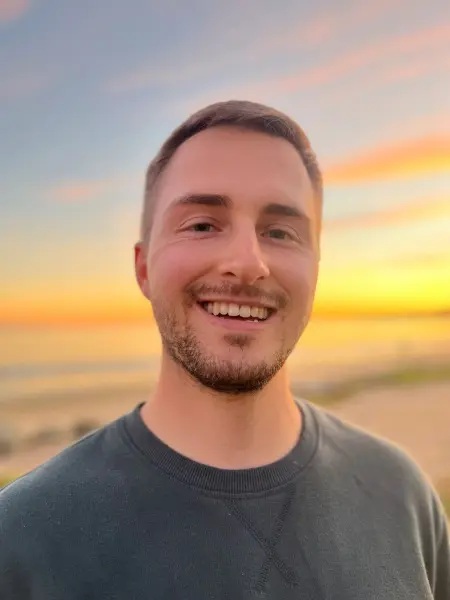 Kyle Mayl (he/him/él) is a multilingual writer based in northern Colorado, where he lives with his partner, two-year-old doodle, and an abundance of houseplants. When he’s not writing, you can find him playing Duolingo, riding his bike around town, and exploring local parks with family and friends. His work explores the absurdity and possibilities of language.