Amit Majmudar discusses his poetry in the Spring 2025 issue of Colorado Review with editorial assistant Samuel Ellington.
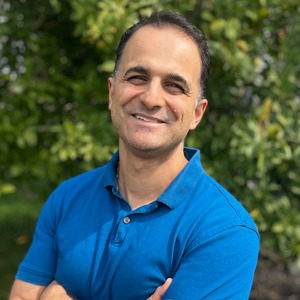
Amit Majmudar is a diagnostic nuclear radiologist in Westerville, Ohio, where he lives with his wife and three children. Recent and forthcoming books include Twin A: A Memoir (Slant Books, 2023), The Great Game: Essays on Poetics (Acre Books, 2024), the hybrid work Three Metamorphoses (Orison Books, 2025), and Things my Grandmother Said: Poems (Knopf, 2026). More information at www.amitmajmudar.com.
Samuel Ellington: Dr. Majmudar, I understand you’re a full-time diagnostic radiologist, in addition to being a writer. This first question I ask somewhat facetiously, but I’m curious: What’s it like being a poet with a day job? How do you find that these two projects inform each other?
Amit Majmudar: My day job is as a radiologist, and this involves analyzing thousands of images a shift and preparing reports for clinicians. That requires close observation and accurate description—no poetic license allowed. Measurements, attenuation coefficients, clear lists of potential causes of the abnormality, and recommendations. Yet there is also a role for ambiguity because certain abnormal appearances can correspond to different processes, requiring different treatments.
Poetry is similar in that it benefits from observation and description, and it, too, has a place for ambiguity. But with poetry, imagination can interpolate what it dreams up, and I can leave things out if I so wish. There is nothing external to the self to which the language owes ultimate fealty; in a genre like the persona poem, even the self can be dispensed with. Radiology is diligent, image-constrained ekphrasis, enunciated carefully into the dictation microphone. Poetry is freewheeling, incanted playfully into the void.
SE: Wow, what a delicate, beautiful dance, engaging with both of those disciplines in the same life.
Speaking of disciplines that might seem disjoint but are actually deeply related, I’m drawn to the explorations of mathematics in your poems. Reading your recent work in the Colorado Review, I notice circlings of concepts like zero, scarcity, convergence, and proof—all deeply mathematical. It brings to mind a quote from the mathematician Karl Weierstrauss, that “a mathematician who is not also something of a poet will never be a complete mathematician.” Could you speak about the presence of mathematics in your work?
AM: One of the older ways of referring to verse, in the English tradition, was calling it numbers, in reference to the counting that poets do routinely, or at least used to for centuries, when poetry’s sine qua non was meter. “I lisp’d in numbers,” wrote Alexander Pope, “for the numbers came.” Meters are described in relation to their numerical quantities: trimeter, tetrameter, pentameter, hexameter, and so on. The act of counting is the primary poetic act, and the sacred number is probably two; for it takes two things, in connection or likening, to make a metaphor or simile, and rhyme comes into being through pairing. That is also the number underlying the bilateral symmetry of human life, and most of advanced biological life on earth generally, whether reptilian, avian, or mammalian. As a poet, I am often thinking in mathematical terms. For ending a poem well gives me the same satisfaction as solving successfully for x. But the beauty and pluripotentiality of poetry means that x stays variable, though the poem makes the unknowable a little less unknown.
SE: I love that, “the poem makes the unknowable a little less unknown.” Yet implicit in the notion of the unknown is the possibility of proof. This next question is from my mom, who read your piece “Unnatural Intelligence” and asked, “Can anything really be proven?” What’s the role of proof and proving in your work?
AM: I might have quoted Keats to you many years ago, who wrote in a letter how something can be “proved upon our pulses,” or Emily Dickinson, who wrote that she knew a poem was really a poem when she “felt physically as if the top of [her] head were taken off.” But those are still subjective responses, physiological or psychological, and for a long time now, I have come to believe that there is no proof of what is or isn’t a poem. “Unnatural Intelligence” could have easily been rejected at Colorado Review, languished on my laptop, and been forgotten by me, never published or collected or read; many another reader of the same issue might have thought it a bad poem, or an indifferent one. There does not seem to be any reliability of reader response. I myself have cast a cold eye on the poetry of Nobel laureates and Pulitzer Prize winners and beloved bestselling poets. So when it comes to poetry, I think there is no objective “reality” to the poetic, nothing Euclidean about the geometries of form. But it is precisely that unprovability which keeps poetry unknowable, elusive, fascinating, chimerical, deceptive—and creatively irresistible. The Muse maddens her lover because the Muse withholds her love.
SE: What a gorgeous portrait of the poem and poet! It’s clear from the way you talk about your craft that you’re an avid reader. By whom do you find yourself inspired? Is “inspired” the right word?
AM: Ah, that is a very easy question to answer: Everyone, and everything. I never know what might find its way into a poem. Mostly I am inspired by what I read, however; and this is very often not poetry at all, or poetry very old from cultures and eras that do not resemble ours in their conventions and assumptions about the art of poetry. But I do think inspired is the correct word, since I do everything I can to make literature (poetry, drama, fiction, and quality nonfiction, usually history) the air I breathe, intellectually. Though occasionally I do expose my delicate olfactory apparatus to the fecal miasmas of contemporary politics—American politics, occasionally European or Indian politics—it’s never for very long at a time.
SE: Are there writers whose work you find yourself returning to over and over again?
AM: Absolutely! That would be Shakespeare for me, the perennial energizer of my art. I have also reread Ovid, Homer, and Byron’s Don Juan recently, as well as Eric Hoffer’s The True Believer, Cormac McCarthy’s Blood Meridian and Toni Morrison’s Beloved. Among poets, the poetry of Christian Wiman, who has a new book coming out this summer. I also dip into Oswald Spengler’s The Decline of the West whenever I want to think in large-scale, historical terms. I recently rediscovered John Steinbeck, whom I had only read in high school because he was assigned to us; I avoided him because I associated him with well-meaning English teachers, assigning us what would edify us; that was a mistake, and I will probably read his complete output, eventually. The Bhagavad-Gita is in a category by itself and can’t really be mentioned in the company of ordinary books. I translated it many years ago; my awe did not decrease with familiarity, rather it increased the more closely I investigated each line and word. I may return to the following books over the next few years: Part II of Don Quixote, The Canterbury Tales (I do plan to study Chaucer’s “minor” works as well, like The Book of the Duchess), Henri Charriere’s Papillon, Moby-Dick, Tolstoy’s Resurrection. Though I may defer those in favor of whatever else comes to mind. I do think it is impossible to reread Madame Bovary enough times.
SE: It sounds like you have some excellent times ahead of you, then!
Dr. Majmudar, it’s been an absolute pleasure to chat with you and get to know a bit more about your practice. I could keep lobbing you questions forever, but for now, I’m wondering what’s sustaining your work as a poet in the US in 2026?
AM: I find myself driven by curiosity about what I have not yet written. My poems compose themselves before my eyes, and sometimes my practice approaches the state that Zen practitioners call “No-mind.” I am genuinely surprised by what I write, and I am eager, every day, to see what the screen will surprise me with. This holds for poetry and prose as well, really. If you asked me to summarize an unwritten poem before I wrote it, I would either describe something different (and weaker) than what the poem ends up being, or I would find nothing to say at all, or maybe an incoherent phrase or random rhyme-sound or something. I don’t think that’s all that odd because people don’t think then speak, or think then write; the act of speaking or writing conjures the thinking and feeling, calls the experiences and memories into place. I create vacuums in the sound-shapes of poems, and the words rush to fill them in. Right now I am writing a sonnet sequence about time, in dialogue with our collective ancestors who are also our descendants because of the circular nature of time. It is just strange stuff, stranger and stranger, my own voice and their collective voice interdigitating in the same poem. I am curious to see where it goes. Right now they have been explaining how they are always watching us and are forced to inflict partial apocalypses on us to keep us from annihilating ourselves completely—floods, plagues, and so on—and that there are two factions among them, one that wishes to preserve us and the other that wishes to partially destroy us, to throw us back to an earlier stage of civilization, as happened after Çatalhöyük and Atlantis. Why am I even writing this? No one is going to read it. Where is it even coming from? I have never had any of these thoughts. Two weeks ago I hadn’t even conceived of the project. What sustains me in 2026 is the exhilaration of having exited 2026 entirely. The exhilaration of having exited myself, of being, in a sense, “out of my mind.”
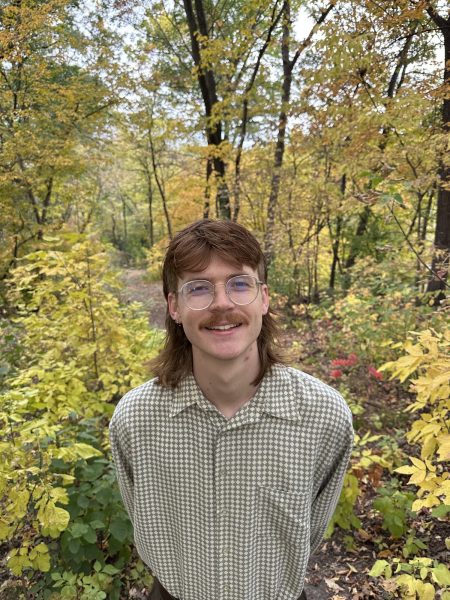 Samuel Ellington is an instructor and student of poetry at Colorado State University and an editorial assistant at the Colorado Review. His writing has appeared or is forthcoming in Phoebe, South Broadway Press, Cellar Door, and elsewhere. He’s a North Carolina native, and he’s loving his new home.