Catherine Esposito Prescott discusses her poems featured in the Fall/Winter 2024 issue of Colorado Review, Supporting Women Writers in Miami (SWWIM), and her forthcoming collection, Superbloom, with editorial assistant Kyle Mayl.
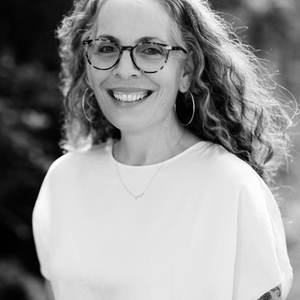
Catherine Esposito Prescott is the author of four poetry collections, including Superbloom (forthcoming from Gunpowder Press, February 2026) and Accidental Garden (Gunpowder Press, 2023), winner of the Barry Spacks Poetry Prize. Prescott is the co-founder of SWWIM and editor-in-chief of SWWIM Every Day. See http://catherineespositoprescott.com
Kyle Mayl: Your poems featured in the Fall/Winter 2024 issue of Colorado Review navigate both immense grief and persistent hope. The series becomes, as “The Ride” puts it, “a swirl of love and loss, pain and triumph.” Could you talk about the experience of writing through these nuances?
Catherine Esposito Prescott: I can try. I think I was trying to understand my way through by writing. Life is hard. My middle son, Austen, was diagnosed with a rare pediatric brain cancer at the beginning of his senior year of high school. These poems were written in response to that time. I only wrote maybe two poems while he was sick because as a writer, sometimes we foresee things. His illness was something I didn’t want to see the end of because there was no good end.
A few months after he passed, a dear friend of mine came over and made me start writing again. It felt impossible. Because how to make sense of the senseless, right? But I think that’s often where our deepest and most vulnerable work comes from.
So these poems are from that juncture of my life where my son’s physical life was over. And then what? What do we do now? How do we go on? How do we honor this? How do we make sense of this? Where is he? All of those questions. Is he gone gone? Is he just a little bit gone? Is he in another dimension? This work is a response to that.
KM: How did you enter that space of being able to write about the unimaginable? Thinking about losses in my life, sometimes I feel like writing is an insurmountable task.
CEP: I will be honest with you: I had to trick my brain into starting again. The writing happened after some physical, emotional, and spiritual healing. First, I had to heal my energy, my body. I went to different energy workers. Then I was able to walk more than a few blocks at a time again. Then I started cycling long distances. And then I was able to sit for a moment to start to write. But I couldn’t just begin writing. My brain was like, where do we begin? I had this huge, heavy shadow in the background, and I didn’t know how to start tacking it to the paper. I had to heal a bit first before that was possible.
I’m in a writing group called the Matrix. Each week, we create a word matrix and write from that. But I hadn’t seen them for most of the year when Austen was sick. So I took each word matrix from that year, printed them on cardstock, cut them up, and then let the words fall to the page, almost like confetti. I wrote around wherever the words landed. I never knew what would come from these poem experiments. My brain was such a miasmic soup. It was just wrecked. It was like I lived inside a gong that someone had banged repeatedly. When I came out, there was no coherence. So little tricks helped me.
KM: On a separate note, I noticed that many of your poems offer deep attention to the creatures and features of particular locations. What is your approach to mapping place via poetry? How do you conceive of a poem as a place, if at all?
CEP: I’ve never thought about it that way—a poem as a place. But I guess it is. And certainly mine are. For me, place is often a point of departure. I do this repeatedly in my work: go from the microscopic to the macroscopic.
And I love landscape. I think that’s part of it, too. I love the natural world, and it’s highly ironic because I’m allergic to everything. But I go to these spaces for clarity. To calm my nervous system. To attune. When you have that kind of embodied practice, then you open. Then the poems come. You can hear them. For me, it’s a very organic process. I always return to nature, however I can. Just to ground. And to heal.
I’ll go to the Everglades and bike and say, oh, there’s a poem. But sometimes it’s an urban landscape that’s a little bit different from the one that I’m used to. It’s almost like a walking meditation when I’m in a place that’s completely new or that I haven’t been to in a while. My eye is drawn to different things, and I pay closer attention to my environment. It forces my brain to work in a new direction, which may give rise to different thoughts and different language. It’s the same way that dropping words onto a page, erasing half a poem, or working with a document allows my mind to enter a new space.
KM: Many of your poems grapple with remembering, representing, and communicating with somebody who has passed. Why use poetry as the medium for this?
CEP: For the last three, four decades of my life, poetry has been my main mode of expression. As hard as it was to write this work, I couldn’t imagine not writing about it because it took up so much space in my subconscious. Somehow, I would have to get through all of it in order to live on. Thank goodness I have poetry. Thank goodness I spent decades working on a craft that would help me interpret this horrific experience.
What we do with poetry is we make meaning, right? We make meaning of our lives, the lives of others. We’re always trying to create order out of chaos, and poetry definitely helped me create order out of extreme chaos. It was a way to work through and try to make sense of the senseless. Because Austen’s disease was senseless. It came out of nowhere. The doctors said that you have a better chance of getting struck by lightning than getting this disease, especially if you’re completely healthy, no preexisting conditions, no hereditary factors.
Poetry is true to emotion. Even if the narrative is not chronologically exact, the emotional trajectory, for me, always has to be absolutely spot on, honest. I had to work through the subconscious emotional buildup of the year in order to move on. Now I’m working on a nonfiction piece about our experience, but I had to get through the poetry first.
KM: I see references to rishis, reincarnation, and wisdom traditions alongside chemotherapy, experimental medicine, and biology in this series of poems. How do spirituality and science interact in your work? In your mind, what’s their relationship?
CEP: I’m probably the least woo-woo person there is. For me, spirituality and science are both very logical. For me, they work together, not separately. They’re fully integrated, and I don’t sacrifice one for the other. For me, this thing is true, that thing is true, and maybe this other thing is true. It’s more like a quantum logic. At least that’s what I describe to my students.
I am a student and teacher of yoga philosophy, so that’s where the rishis come in. They were the super Yogis of ancient times. A lot of their philosophies—darshans, or ways of seeing—are very different from how we think in the West. In the yogic tradition, a foundational tenet is that consciousness is primary. Everything begins with consciousness. Consciousness comes into a body and then leaves a body. In the West, it’s still very much perceived that consciousness originates in the brain. It’s a very different paradigm. But it seems like at least some pockets of the West are now opening up to this other way of thinking.
It can be very disorienting, but in my case it was reorienting. Many of the ancient yogic teachings influenced writers in the West, from the transcendentalists on. We’ve inherited a lot of these thoughts and logical systems without being fully aware. You know, Ginsberg says, “I always wanted, / to return / to the body / where I was born.” Well, what was he talking about? He was talking about returning to source, returning to that place where we come from. As the Yogis said, we’re never born, we never die. I think I talk about that in one of my poems. We change form.
That whole thought—is death a birth and is birth a death?—it’s like an open door. It’s fascinating, and it also takes the edge off of extreme, complex grief. Because if you just have grief to hold onto, it can become an eddy, a swirling that takes you under. But if you have this other thing, this maybe, it can be a portal into something else. That’s my hope for these poems. That grief is not just this, and it’s not just that. It’s both. It’s a place where pain and wonder live side by side.
KM: You’re a co-founder of SWWIM (Supporting Women Writers in Miami) and editor-in-chief of their daily online journal SWWIM Every Day. Would you mind telling me more about these projects and their goals?
CEP: Thank you for asking! SWWIM is a nonprofit we founded in 2016. We’re going on our tenth year of programming. SWWIM is a platform that builds community among women writers and amplifies their voices. Jen Karetnick and I thought of this organization maybe fifteen years ago. At that time, whenever we would go to a reading, we would maybe see one woman reading with three guys. We wondered if there were more women writing in Miami and where they were. We wanted to find them and to create a year-round reading series in Miami.
We began with a writer-in-residence and reading series at the Betsy Hotel, which we still curate and coordinate today. We invite writers from around the world to apply for the residency. When our writer-in-residence is in Miami, we pair her with a local writer for a poetry reading.
Within a year of SWWIM’s founding, we decided to start publishing a poem a day. Well, Monday through Friday—we’re not complete masochists. We invited friends to submit and our communities to submit, and now we have a pretty robust platform going on almost nine years. My math isn’t exact, but it’s a much longer time than we ever imagined we’d be doing this.
We’re starting to do more arts activations, SWWIM salons, and partnerships with a lot of local organizations, from the Miami Book Fair to O, Miami, and art galleries. We’re really excited to be partnering with the Elevate Prize Foundation, which gives grants to people who are changing humanity, who are elevating the global consciousness. They’re piloting this program in Miami called Elevate Cities. As part of that program, we’re helping them produce a poetry contest called Sonnet Boom: Love Poems for Miami. You don’t have to live in Miami in order to enter the contest. It’s open to anyone who loves Miami. There will be a cash prize offering!
KM: That sounds wonderful. Before we go, I want to talk a little bit about your newest poetry collection, Superbloom, forthcoming in January 2026 from Gunpowder Press. First of all, congratulations. That’s really exciting. How did this project come about, and what do you hope readers will encounter in it?
CEP: Thank you. Superbloom is a collection that mostly spans the time before and after Austen’s diagnosis. It really is a story of love and hope and pain and sadness and celebration.
I never have any expectation for my work. I’m always surprised when it resonates. I hope it resonates.
It’s a tough collection, but hopefully there’s enough variance in it. The first two sections explore different subjects, and then the last section is where the experience starts to go full throttle. There’s no let up. You just go through it with me, with us.
 Kyle Mayl is a second-year MFA candidate in poetry at Colorado State University. His writing explores bilingual play, haunting memories, and the personal-political intersection.