Maureen Thorson discusses her poems featured in the Summer 2025 issue of Colorado Review with associate editor Erin Peters.
 Maureen Thorson is the author of three books of poetry: Share the Wealth (Veliz Books, 2022), My Resignation (Shearsman, 2014), and Applies to Oranges (Ugly Duckling Presse, 2011). Her book of lyric essays, On Dreams, was published with Bloof Books in 2023. She lives in Falmouth, Maine. You can visit her at maureenthorson.com.
Erin Peters: The series of your poems that were published in the Summer 2025 issue of Colorado Review seem to be connected through their grounding in images of nature and their prose form. Did these poems arrive to you as a clearly defined and connected series, or did they begin as something different?
Maureen Thorson: The poems are part of a longer group, the core of the book-length manuscript I’m currently working on. While they didn’t necessarily arrive “clearly defined and connected,” after I first wrote a few poems in this style back in late 2023–including several that appear in the Summer 2025 issue–they started to take on a life of their own.
Each poem in the group is meant as a sort of alternative definition, or gloss, of a simple noun, none with more than two syllables, all of which would have been familiar in the nineteenth century. So, there’s no poem called “The Cellphone” or “The Radio”! Instead, the poems are divided roughly by animals, flora, climate, terrain, household objects, body parts, and some things that aren’t quite tangible (a song, a moral).
EP: It’s so fascinating to hear that these poems are guided by language that would’ve been familiar during a certain century. Can I ask what’s been drawing you to simple nouns from the 1800s, specifically?
MT: The first few poems I wrote in this vein all centered around natural things. In fact, the very first poem I wrote was “The Mountain,” which appeared in the Summer 2025 issue. I really like working in long series, and when I get started on a new one, I find it helpful to impose constraints on myself—whether those are based in form, theme, or what have you. Some of those constraints may fall to the wayside as a series goes on, but they give me a way to channel my energy and keep the poems connected.
When I started writing this group of poems, I was thinking a lot about “real” things and how to situate myself in a world that is increasingly virtual, and screen based. Given that the first few poems I wrote organically turned on geography and environment, I decided that one of my constraints would be only to write about things that were part of everyday life long before people had so many digital, synthesized ways of existing in the world. And while it wasn’t necessarily a conscious decision, I think I focused on the 1800s because not only is it the last century before the development of virtual media like television or the internet, but it’s also more familiar to me through books and history than earlier periods. It’s especially easy for me to imagine New England, where I live now, in the 1800s.
EP: In your poem, “The Tide,” you write “Waves crest and roll over…You could build a million things from this / kind of battering.” Throughout your verse, the speaker seems to take on a blunt yet hopeful tone about what can be formed through suffering difficult circumstances. I can’t help but connect a moment like this to the climate crisis, and so I’m curious to know how you would describe the relationship between the environment and your work as a poet.
MT: If you asked me ten years ago, I would never have described myself as a nature poet. Although my first book, Applies to Oranges, was very much influenced by the climate of North Florida, where I spent a couple of years as a teen. But my adult life has largely been spent in large cities, and so that was the environment my poems mostly moved in. Then, in 2017, I relocated to Maine, where I live close by an Audubon sanctuary, which has several stretches of woods, meadows abutting a river, an orchard, and a pond.
Since then, the climate and geography of New England have become a near-constant theme in my work. The sheer number of poems I’ve written about snow in the past eight years is a testament to that! I’ve also developed a fondness for describing landscape in terms of clothing and makeup–as if the land is playing dress-up with the seasons. And I know it’s a truism, but there is something about the flinty, hardscrabble, wave-swept geography of New England that lends itself well—philosophically—to the “make it do or do without” sensibility that I think you see in “The Tide.”
EP: Your poem “The Mirror” stands out from the others in the series because of its focus on languages and bilingualism. You write, “To get the full benefits of any / language, you need to speak two.” How does this way of thinking about language influence or inform your writing practice?
MT: One of the main themes I explore in the series is the way that we use language to make meaning. I suppose it’s just the luck of the draw that “The Mirror” addresses this theme so much more explicitly than the other poems published alongside it!
For me, learning other languages has been a way of deepening my knowledge of English while also broadening the way that I understand the world. They say that any text can function as both a window and a mirror–letting you see new things while also reflecting yourself back. But reading and speaking in other languages is like unlocking whole new palaces’ worth of windows and reflective surfaces. At heart, language is an attempt to bridge the gap between our minds and the world–and different languages bridge that gap in different ways.
EP: You began writing a poem a month in April of 2003, a practice which quickly gained traction among other poets and became the popular NaPoWriMo project. I imagine it’s inspiring to see how many poets now participate in the project. How has that community impacted your writing?
MT: When I spent April of 2003 writing a daily poem, I never would have guessed that the project would still be going more than twenty years later, much less that it would draw such a following. A core group of poets participates every year, and there are regular flows of new participants and poets who return to the project after some time off. One of the most gratifying aspects of the project is how supportive people are of each other’s work. Our comment section is very welcoming. It warms my heart to see participants take inspiration not just from the prompts we provide, but from each other.
I don’t necessarily always write a poem a day in April myself–keeping on top of the website is enough for that month! But I have gotten into the habit of writing a poem a day in other months, maybe three or four times per year. I usually don’t go into this with any prompts or ideas, but I’ve found that it allows me to slowly write my way into a theme, discovering it as I go, over the course of a month.
EP: If you’re able to share, I’d love to know more about what projects you’re currently working on and what sustains your work as a poet.
MT: I’m currently working on the manuscript that contains the poems published in the Summer 2025 issue. The full manuscript is mostly prose poems, but I’m also writing several longer, loose-lined poems. I’ve been building those poems using a word bank that consists of the alphabetized text of the prose poems and a few public domain texts from the late 1800s. I say “building” because the process is reminiscent of putting together a jigsaw puzzle, but without a picture, and doing it very, very slowly. I’m having a lot of fun with it, and yes, you can reasonably guess that I am the sort of person who thinks jigsaw puzzles are fun.
I get a lot of inspiration from my daily walks, as well as from my writing group, the May Street Poets. We meet once a week for dinner and to generate new poems. Members’ writing styles differ considerably, and I find it very helpful to hear work that engages with so many distinct themes and techniques. It gets my mind working in different grooves.
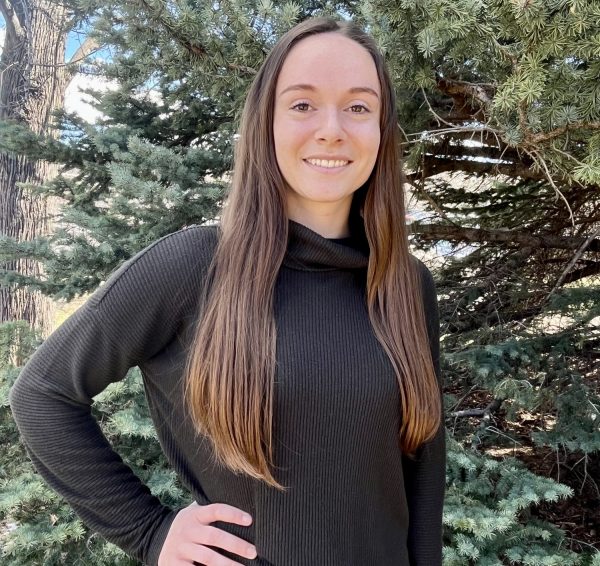 Erin Peters is an MFA candidate in poetry at Colorado State University, where she serves as an editorial assistant for Colorado Review. Her writing is interested in the connections between desert environments and the human body.