Calla Jacobson discusses her essay “Hills, Birds Bones,” featured in the Spring 2025 issue of Colorado Review, with associate editor Liz Ramirez.
 Fulbright recipient Calla Jacobson has a PhD in anthropology and an MFA in creative writing. She is hard at work on a memoir about her experiences with culture, community, storytelling, love, and unexpected consequences in Nepal during the last decades of the twentieth century. She makes her home in Colorado.
Liz Ramirez: What was the catalyst behind the writing of this essay? When did you start to see these connecting threads between the bird story you were told in Nepal and your mother’s decline?
Calla Jacobson: I started writing the essay sometime in the mid to late 2010s. Originally, I thought it was going to be a chapter of a memoir about my research on stories in Nepal in the 1990s, and the unexpected pregnancy and complicated family connections that came about during that time. I thought my mother’s death was part of that story, but it wasn’t. I was confusing one project with another, because I was obsessed with both of them.
As far as I can remember, the myth of the bird-girl was part of writing about my mother’s death from the very beginning. I don’t recall a specific moment when I connected them, but I’ve been really haunted by that story, and by some of the other stories I was told, for a long time. After my mother’s death, this one particular story began to speak to me in a new way, in a really different way, about love and obligation and regret and what we can—and what we can’t—give to our elders (and also to our children). It became very personal.
When I finished my MFA and set that memoir manuscript aside to breathe—because it really needed to breathe—I wanted to write some essays. The first thing I knew I wanted to work on was this one. It was structured really differently then, because I just told the story of climbing the hill and hearing the myth and then told the story of my mother in the hospital. The parts didn’t connect, and I had shoehorned them into the wrong context.
One interesting thing that happened when I workshopped it in it’s earliest form was that people told me the strand set in Nepal was written much more vividly and more lovingly than the strand set in Colorado. I think that was because I hadn’t yet been willing to go under the surface of what my mother’s dying had been like and really figure out what it meant for me. I had to face my regrets and my sorrow. Now, the piece is framed in Colorado rather than being framed in Nepal, and I think—I hope—I was able to access tenderness for all of it in the end. Also—this is something that’s not explicit in the essay, this is kind of meta—but I feel a connection between the bird-girl, who was so full of remorse and shame and sadness that she could only ever use her voice to say one thing, and my efforts to use my voice in service of a similar grief—in addition to my hope to find a way forward, which the bird-girl could not do within the confines of the myth.
LR: I think that the last line really speaks to that, the “let her go, let her go, let go.” I do think you really tapped into that tenderness in both of landscapes that you write about here, and the birds the thing that unites them.
I’m curious as well about something related: the temporal frame of this essay is just so expansive. It really covers three, maybe even three and a half decades, from Nepal in the 90s to the scattering of ashes in 2019. I’m hearing you talking through some of the ways in which you had to maybe reprocess your mother’s death while you were writing this. Did you find that you needed a certain amount of distance to kind of really see events for what they were?
CJ: Yeah, I need all kinds of distance. I don’t know really what that specific amount is, but it’s a lot. I mean, I look at memoirists and essayists who write about recent events, and I’m just amazed, because they often do have a nuanced take. But I don’t think I could do that. It takes me a lot of time to process and to be able to bring to the work the level of understanding and the different kinds of perspective that I need. Honestly, I wouldn’t have written about my mother at all when she was alive. That’s not because of any rational calculation about what she would think or how it would affect our relationship, but it wouldn’t have occurred to me. Because that fear of displeasing her was so primal, it would have prevented the idea from even coming to me.
But back to perspective, I wanted to comment also on the line about the mountains that you pulled out.
LR: Can I read that real quick?
I just think this is such a beautiful sentence in the way it speaks to the distance necessary for perspective: “From where we sat, we could see the mountains in a way that is never possible from within the mountains themselves…” (p. 3 of “Hills, Birds, Bones”).
CJ: When I wrote that, it started with the literal moment of where I was and what I could see, but I almost immediately thought of it as a metaphor for the anthropological gaze and the deliberate attempt to learn a new world—usually from a position of privilege, which is another conversation— the way one ends up in between a new world and the home world, with a transformed vision of both. But, of course, you’re right that the line speaks very much to the perspectives of time and distance also. And I love that you saw that in it and that you connected it to the writer’s process and the writer’s experience.
LR: This is such a skillful example of a slanted detail that, you know, means what it means in the story, but it also gestures toward a bigger truth. I think that was just really beautifully done.
It sounds like this essay has been in the works for quite a while and underwent many transformations in the drafting process. The last event chronologically in it is the scattering of your mother’s ashes in in 2019. I’m curious about how you know when it’s the right time to let go of a piece of writing, specifically one that concerns a relationship of such central importance as the relationship between a mother and daughter. How do you know when it’s ready?
CJ: Well, you know, you’re asking the woman who carried her mother’s ashes in the back of her car for years. But I really like the way you connect the scattering of the ashes here, because I think that helped me let go of my mother enough so that I could actually go deeper into what the story of the bird-girl was telling me and what I needed to understand about my relationship with my mother. So, in a way, letting go of her ashes was a prerequisite to being able to finish the essay.
And with writing, specifically, I don’t send a piece out until I’ve worked on it a lot and had other people look at it . At some point it begins to feel right to me. That’s not the same as finished, but at least it feels whole. When I can set a piece aside and come back to it and read it and feel that the parts are connected and it has its own integrity and is starting to be something that’s outside of myself and not just an extension of myself, then I can send it out.
But, truly, it’s only finished for me when something external stops it in time, freezes it, and captures it in a fixed form—like a publication. Every time I submit, I revise. It might just be tinkering with sentence rhythms or it might be bigger revisions. And sometimes I know there’s something that needs changing, but I don’t know what it is. There were a couple of things with this essay that I just hadn’t been able to see even through all my revisions. I’m so grateful to everyone involved in the editorial process at Colorado Review—and I don’t know who those people are, for the most part, but they looked at my story with those clear eyes, and they showed me the view of the mountains from outside the mountains and helped me get the piece to finished. And I’m so pleased with how it turned out and how it looks on the page, just everything.
LR: The metaphors you use in this piece are serving us so well in this conversation. I think that’s so cool. I really resonate with what you said about an essay feeling “complete” when it’s no longer just an extension of yourself; it’s now something that’s started to move and exist outside of you. As I was reading this, I was thinking about how one’s identity is so bound up in who your parents are and your relationships to them, and how much trouble I would have getting a piece of writing about my mother to a point of completeness there. And I’m still learning how to make something that has that completeness that you mentioned, that doesn’t feel trite or like it comes to too easy a conclusion. I think you beautifully avoid those pitfalls here.
CJ: I mean, that’s such a challenge, right? To make an ending that both satisfies and doesn’t do too much, that leaves room for the reader to think, Yeah, there’s more that can be said here.
LR: And engaging them in that that collaborative meaning making process rather than just serving them a prepackaged meaning from your perspective.
CJ: As an academic, that’s a hard thing to learn, because academic writing tends toward over-explaining. But this is such a different kind of writing and such a different kind of coming to a “conclusion”— trying to bring some things together, but also to leave space for expansion.
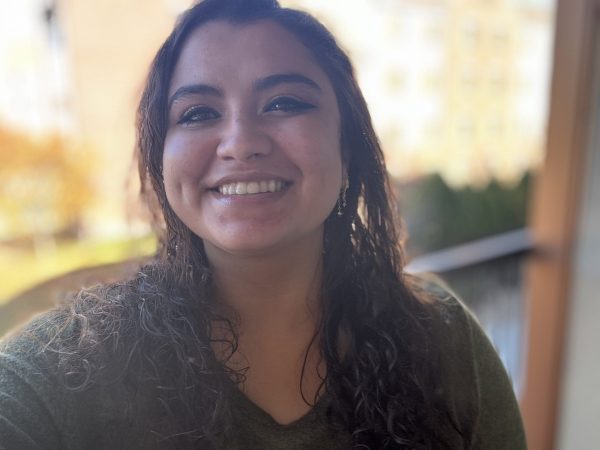 Liz Ramirez is a writer, a Texas transplant, and an MFA candidate in creative nonfiction at Colorado State University, where she writes about family, hybridity, and liminality in racial identity. Her poetry and nonfiction appear in OyeDrum, Olit, Women on Writing!, and elsewhere. An editorial assistant at the Colorado Review, in her free time she enjoys singing, reading fantasy fiction, and playing copious amounts of Stardew Valley.