Editorial assistant Andy Parker discusses family, teaching, and adolescence with Anne-E. Wood, the author of “Losing It,” featured in the Fall 2024 issue of Colorado Review.
 Anne–E. Wood is a fiction writer who lives in Brooklyn. Her work has appeared in Colorado Review, TLR, Tin House, No Tokens, New Letters, and elsewhere. She was a Yaddo fellow and has an MFA from San Francisco State University. She is an Associate Professor in the Writing Program at Rutgers Newark.
Andy Parker: In “Losing It,” loss seems kind of like a slippery concept. I was just wondering if you would be able to speak a bit about how you were thinking about loss and the various ways it manifests in this story.
Anne-E. Wood: Yeah, so I think when I started writing it, it was the concept of losing your mind, like the mom losing her mind. And I actually really did focus on the mom at first, that she was sort of in this place in her life where she’s uprooted and unanchored, and so are the kids. So the mom’s losing it, and June is aware of this, so there’s this sense of a lack of balance in the world. And the other thing, too, was the wind, actually. The mistral in the south of France actually drives people crazy, historically, because the wind makes the doors slam and the shutters rattle. And so I liked the idea of people just going crazy during this time.
And I think the other stuff about loss, the losing her sister on the train and the sense of responsibility June has… She loses her sister, so she hasn’t been responsible, but she’s also free. So there’s this glimpse in a world where she also gets to be uprooted and detached from her family. And then there’s the losing the opportunity at the end, too. I don’t really think linearly as I write, and definitely not thematically, but I think that in the end, it’s about just the loss of opportunity—or June thinking that she has, even though it probably saves her, because meeting this random stranger on a train sounds romantic, but it’s probably not a great idea.
AP: When you were creating the sibling dynamic between June and Edie, how did you figure out how they were going to play off of each other? Is there something that draws you to writing siblings?
AW: So, I come from a family of five siblings, and we’re all very close in age. I never planned for them to influence my work in any way, but no surprise that they have. Actually, my entire identity has always been around just being part of this pack, but also trying to find my own identity within it, and also freedom from it, right? But I’m just profoundly psychologically influenced by my siblings—each one of them individually, and also who we are in relation to each other. And I think a lot of the tensions that I find in my fiction, there’s always a sibling there. For me, it must be primal, because those are the moments where there are the highest stakes.
And also, you don’t have the freedom to walk away, right? There’s this person who’s creating drama for you and you have a sense of responsibility to, and you love and hate, right? It just creates this tension that’s in all the stories I write. It’s funny because I never plan out, “I’m going to write a story and it’s going to be about brothers or sisters, or this family dynamic, and it’s going to be really tense.” I really start off with these situations, and then the characters, they just start to interact, and they become locked in whatever drama they’re in.
AP: So in this story, June and Edie are moving in between places on this train, and then they’re also moving in between adolescence and young adulthood. I was wondering if there was something drawing you to that kind of in-between character or setting.
AW: Well, I think that’s just sort of the state of adolescence, right, is that you’re in-between. Edie is in those pre-teenager years where you might not have enough knowledge to feel this profound sadness that might come in later on. Or it hasn’t built up yet, where you really want to burst and you’re ready to get free. And June is, right? She’s ready to go. And I think that’s the metaphor, not just for adolescence, but for the rest of life, is that you’re free but also bound. And you don’t know what you want, but you’re also not allowed.
Although, there is this thing, too, where the mom sends them away. And this did happen to me a lot when I was a kid, when my siblings and I would just kind of be somewhere, and it’d be like “Well, that’s your cousin, so go stay with them for a while.” And so there was this, “Where are we going? I have no idea.” But there’s this world out there, and there’s immense possibility, but they’re bound to each other. But I think the tension of thinking you know what you want and not being able to get there kind of locks in the drama for both of them psychologically.
AP: One of the things that immediately compelled me to “Losing It” was the style of narration. There are these wonderfully winding, voice-y sentences that are sort of underscored by the repetition of the “it was [blank]’s fault” phrase that acts like a drumbeat throughout. I’m curious how much you’re thinking about the cadence or rhythm of individual words as you’re writing. Does this musicality come naturally to you, or is it something you cultivate intentionally?
AW: Well, I would say it comes naturally. And I think that’s what I do when I write, right? So, for me, it’s not about complicated plots. For me, it’s about the line. It’s about the theater, too. It’s about the theatricality of the sentence, the drama of the sentence. And it always has been since I started writing, which was when I was very young. And I don’t know where that influence comes from other than I just grew up in a house around music. So I don’t know if it’s a musical thing, but I think that’s what I love to read. I love a sentence. You know, I love James Baldwin, but I don’t read James Baldwin because the plots or the thematics are so important; it’s just that these sentences are so wild, and there’s so much wildness in this control. It’s almost like a garden. You go to a garden because there’s definitely landscaping there, but what makes us love gardens is the wildness, right? It’s the possibility there. And I think for me that it’s all about the sentence.
Am I aware of it? I think once you become too aware of it, it’s bad. It topples into really purple, over-wrought writing. So I think it’s understanding how to pull back on those dynamics when necessary. The sentence has internal logic, and you can play with that logic, how one sentence plays off the other. And I don’t know if there’s a method that you can learn to do that. It’s just a sensitivity. I’m sensitive to the way words sound together, to what a paragraph does and how a paragraph can shift. And that’s what I like to read, and that’s what I’d like to master by practicing.
AP: In your bio you mention that you’re an associate professor in the Rutgers University–Newark Writing Program. I’m curious how you think about your roles as both a writer and an educator. Do you find that one role influences the other in any interesting or surprising ways?
AW: I think for me, part of why I love teaching is because I don’t love sitting at a desk. You know, I have to sit down to write anyway, so I like being up, and I’m kind of an extrovert. I like performing. I like being in front of my students and working with them. I love having a goal, but then also being able to improvise. Especially these days, you really have to work to get young people to pay attention, so I like that challenge.
In terms of composition, what I like about it is that it’s so different from creative writing. I like thinking about writing in another way, where it really is all about clarity and logic and having a point, which is really the opposite of fiction, which is where you really want to stay away from having too much of a point, you know? But I think that process-wise, I’ll tell my students, “Just sit down and write for two hours without stopping, and see if you can write this eight-page essay just by doing that. Just see what comes out in one draft, one sitting. Don’t think too hard.” So, sometimes I’ll do that and see what happens. You know, take the advice that I give my students.
And one more thing, I never understood how important verbs were. I’m constantly telling my students, “What is driving the sentence? What is the verb?” And I think about that more as I’m editing my own work. I think, “Well, what is the main drive of the sentence? How does the subject find agency?”
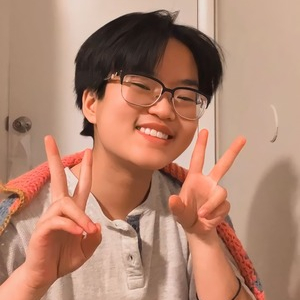 Andy Parker is currently working toward his MA in literature at Colorado State University, where he serves as a first-year composition instructor and editorial assistant for the Colorado Review. Born in China and raised in the US, their research centers contemporary narratives of transracial adoption. When not analyzing others’ poetry and prose, they are writing their own, which has appeared in Gasher Press, Beyond the Veil Press, new words {press}, and elsewhere.