Yvette DeChavez discusses “Two by Two,” her story featured in the Summer 2025 issue of Colorado Review, with associate editor Tyra Lechner.
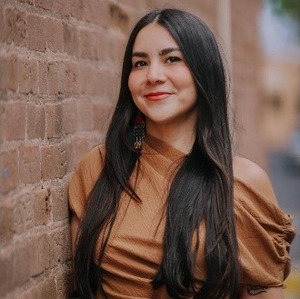
Yvette DeChavez was born and raised in San Antonio, TX. She earned a PhD from the University of Texas at Austin. Her writing has appeared in American Short Fiction, Passages North, and Los Angeles Times, and she’s received support from the Macondo Writers Workshop, Storyknife, and Hedgebrook. She’s working on a novel.
Tyra Lechner: Even though “Two by Two” takes place entirely inside, I could feel the weight of both San Antonio and New Mexico within this piece. How do you think place usually shows up within your writing?
Yvette DeChavez: Place is the realest thing in any story I write, which is funny considering most of what I’m currently working on is set in a fictional town. (But that town is very real to me!) When I’m figuring out my characters, it’s always in relation to where they are and how that place impacts who they are. I think this is because I’ve never felt completely connected to a place. I grew up in San Antonio, but both of my parents were born and raised in Albuquerque, so Texas never completely felt like home and neither did New Mexico. Every year, we took road trips to visit my grandparents and the rest of the family. I spent a lot of time looking at the land zoom by, watching how it changed from here to there. But beyond the land itself, I was always searching for what made me Texan and what made me New Mexican, both on an existential level and in more tangible ways, too, like eating breakfast tacos instead of burritos or saying y’all. So, place is always showing up in my work in these more subtle ways. For “Two by Two,” I talked to my cousin in New Mexico about lightning, because I knew it was different there with the mountains and wide-open space. (Shout out to Angel, without whom this piece wouldn’t be what it is.) Even something like that is so particular to a place.
TL: Staying on that note of place, you wrote in an Instagram post that this story was loosely inspired by events in Clovis, NM. Can you talk about how you find inspiration?
YD: Yes! On one of those road trips from San Antonio to New Mexico when I was about ten, my mom and I got caught in a tornado outside of Clovis, which is right on the New Mexico/Texas border (fitting). It led to my great fear of tornados. In general, I write about the things I can’t forget. Sometimes, it’s small stuff: the smell of a certain perfume or a time someone mispronounced a word and made it more beautiful. These become sparks for something bigger. Most often, though, inspiration comes from my family. My parents and brothers are all storytellers, and I’ve spent my life listening. Like many families, there’s been a lot of tragedy in mine. My work is an effort to honor everyone who came before me.
TL: This story is really grounded in the senses, bodies occupying space and each other—how do you decide what to focus on? What details deserve attention and why?
YD: Grounding is something I’ve had to work on as a person in the world. I’ve been in therapy for over a decade now, and many of my sessions include a moment where my therapist tells me to put on the brakes, look around, and situate myself in the room. In other words, come back down to earth. I’m thinking about this with my characters too. What spaces are they in, and how do they feel in them? What are they noticing? It varies from character to character. In this story, Gloria is struggling with her desires, both internal and external. Whether she knows it or not, she’s interested in the sensual. She’s aware of things like heat on her skin, what a tongue across a lover’s teeth might feel like. She’s a body on the verge of combustion and all she needs is the right touch—be it a tornado, a man, or herself—to make it happen. She’s looking for it everywhere.
TL: This story dances between who Gloria is, who she was, and who she wants to be. We also see her contrasted with other women in her life. How do you build out characters that are so lived in?
YD: For me, it’s about establishing the emotional core of a character. If I know who they are and the rules that govern their life, it becomes easy to shape how they’d move, what they’d say and think. I’ve spent a lot of time with Gloria, so that makes it easy. I know that it’s more about what she doesn’t say. As someone who’s been scarred by family secrets and religion, she’s all about staying quiet. She rarely speaks her true feelings. Everything is an attempt to protect herself from what might happen if people knew the real Gloria, the one who questions God’s existence, who wants to sleep with strangers, who is scared to admit she might’ve chosen the wrong path.
TL: Would you like to tell us anything about the novel you’re currently working on?
YD: I’m obsessed with family secrets and the ripples they create throughout generations. I come from a very Catholic family, and I’ve seen how religion and, more generally, colonization can affect the outward lives we live. This is what I’m looking at in the novel. Gloria is a central character, along with her mother and sister Leti. It starts with one big family secret that begets more and more until the women find themselves estranged from one another. They’re all just trying to survive as working-class Latinas in a world that asks them to be purer and whiter and cleaner and smarter. But none of it matters—they can follow all the rules and still be left high and dry by the institutions that promised safety. It sounds heavy, and it is, but I try to throw in moments of levity. So much of life in America is absurd, and I think BIPOC communities are great at recognizing that absurdity. We’re funny people, man. It’s not all sad shit.
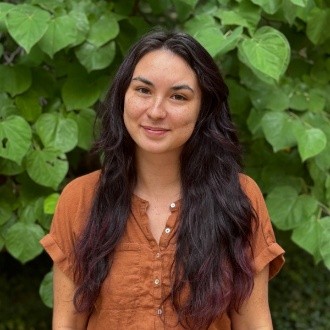 Tyra Lechner is a first-year fiction MFA candidate at Colorado State University, where she serves as an associate editor at Colorado Review and a first-year composition instructor. Her writing has been published in Litro Magazine, HuffPost, Conceptions Southwest, among others. When she’s not writing or teaching, she can be found knitting or rock climbing.