Editorial Assistant Gwynnivere Riethoven talks with Janice Deal about her story, BAE, featured in the Summer 2025 issue of Colorado Review.
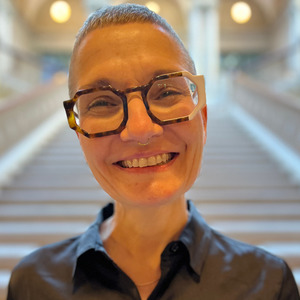 Janice Deal is the author of two short story collections and two novels, most recently the novel The Blue Door (New Door Books, 2025). She is the recipient of an Illinois Arts Council Artists Fellowship Award for prose, and has won The Moth Short Story Prize and the Cagibi Macaron Prize. Janice lives with her husband in the Chicago area.
GR: Could you begin by giving us a summary of your short story “BAE”?
JD: “BAE” is about a trio of characters: a mother, a father, a college-aged daughter, and how they’re trying to navigate loss and uncertainty during the COVID pandemic. Loss is an intrinsic part of the human experience, but COVID brought to the forefront just how uncertain life can be, and the different forms loss can take. I was interested in how these three characters tried to address that uncertainty.
GR: Did you begin writing your story during or after the quarantine?
JD: I started writing in 2021. Vaccinations had already started coming out. As I remember it, quarantine restrictions were loosening. The pandemic still felt close, but there was a light at the end of the tunnel. There was this feeling that COVID was going to recede.
GR: Do you think writing after an event, like COVID, helped you with your creative process? As it takes time to process and reflect on feelings of loss, hope, and hopelessness that are present in your story.
JD: Oh, absolutely. I think that sometimes when we’re in the middle of something, we can’t necessarily get the whole picture. In 2021, though we had one foot still in COVID, we were starting to move forward. I felt like I had a bit more perspective on the year just passed.
GR: “BAE” is such an emotionally charged short story, and now that we’re on the topic of emotions, could you talk about how you layered powerful feelings within your story? Particularly, how you used characters like Sandy and Ronnie to juxtapose feelings of hope and hopelessness.
JD: I was really struck, during COVID, by how everyone was affected and how the impact of COVID took different forms for different people. Ronnie and Sandy are in a position where they’re still working, but the shape of their work has changed drastically – they’re working from home – and there is always the threat hanging over their heads that they’ll lose their jobs. They’re very isolated, and their relationship gets even stronger during this period, at a time when relationships feel more important than ever.
I think that’s the human condition. We thrive in connection with others, and COVID cut at the root of that. People tried to find ways to stay connected; in the story, Sandy tries to stay connected to her sister, who lives in a completely different country. But, in a time of uncertainty, there’s that sense of: will I ever see this person again? Sandy and Ronnie feel this great desire to circle the wagons and draw everyone in their orbit closer, including their daughter Sonya, who is on her own journey.
GR: I feel like Sandy, especially, is navigating these intense emotions of hopelessness and love during the pandemic. What drew you to write about this connection between Sandy and Sonya?
JD: When I started the story, I wanted to explore that very human need for connection, which was put in jeopardy by COVID in so many different ways. I was also interested in the fact that, in times of duress, people have their specific needs. One person might need connection, another might crave individuation. And that can be when conflict arises: when two individuals have needs that are not necessarily the same needs, and they, at least at that time, can’t help each other.
GR: Yes, I think that struggle to connect is something that speaks to a lot of people. One really interesting thing was how you drew on different forms of connection through the use of objects in the story. These everyday objects become devices for your characters to find and also lose one another in. What made you decide to have these everyday anchor points for your characters’ relationships?
JD: I love that question so much! Because I’m really drawn to objects being emblematic of other, deeper things. As I worked on this story, I remembered how I did a lot of jigsaw puzzles during COVID. It became a very meditative process. So, I gave that to Ronnie: it seemed like something he would be drawn to, and of course, working on the story, I realized how a puzzle can represent so many things.
Because let’s face it, life is a puzzle, and we’re constantly invited to put together the pieces. Sometimes the whole image, the big picture, is so unclear when we’re in the middle of something. Also, in the story, employing the crib as an object was interesting to me because there’s this whole tension for Sandy: the crib is a connection to her past. One of the painful things that Sandy is facing is that an object that she and her father assembled with love is not considered safe anymore. It’s no longer “standard.” Things have changed. That is the theme that I am drawn to: how people navigate, not just loss, but change. Which can be viewed as a kind of loss.
GR: So, one thing that made your story so impactful to me was this complex dynamic between family and world. At times, it felt uplifting to see such love from a family; other times, it felt frightening to face the harsh reality of the world. I think this complex network of feelings and relationships is perfectly portrayed in the last scene of the story, where Sandy is helping Ronnie with his puzzle. How did you decide to have this intimate, yet simple, moment be the ending note of the story?
JD: Thank you for asking that. I came to the scene with the puzzle, because I had already written an earlier scene where Sandy and Ronnie go to Ohio to visit Sonya. Sandy has always relied on Ronnie to be the strong one, and in that moment, in Ohio, when Ronnie is weeping, she doesn’t step up. She lets the moment pass. Later in the story, I wanted there to be growth on Sandy’s part. She’s just had this really difficult conversation with Sonya, and she makes the decision while she and Ronnie are working on the puzzle: it’s not that she’s never going to tell Ronnie about the conversation, but she wants to spare him. Just for the time being. She wants to give him that.
That moment, when they’re working on the puzzle, represents so much that has changed. So much that might still change, on micro and macro levels. There are changes in Sandy’s personal world and relationships. There is all the baffling change that came with COVID. And there’s the threat throughout the story about the climate crisis and Sandy finds herself, working on the puzzle that incorporates a snow scene, wondering if someday people won’t even experience snow. All these aspects converge at the end of the story as she realizes, “It’s up to me to remember the way things were.” Because we choose what moments we remember. Sandy decides to remember what has been beautiful about her past, even as life changes and changes again. She does so not only for her own benefit, but for the benefit of those she loves. This choice, for me, dovetailed with her choice to give Ronnie a break by not immediately telling him what had gone down in the phone conversation with Sonya. She makes these decisions in an instant, and they come from a place of love.
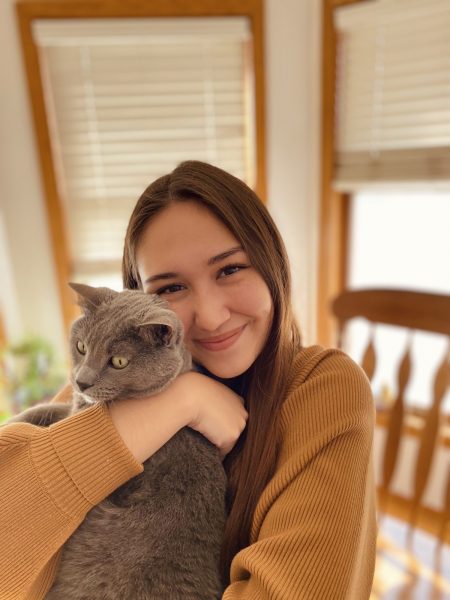 Gwynnivere Riethoven is a second-year MA Literature student at Colorado State University and an editorial assistant for the Colorado Review. Her research interests include language deterritorialization and identity acquisition within the Asian American immigrant diaspora. When she’s not working on her master’s thesis project, she is either reading romance fantasy novels, doom scrolling, or thinking about her cat who lives back home in Nebraska.